
How to Manage Preschool Attendance and Administrative Records
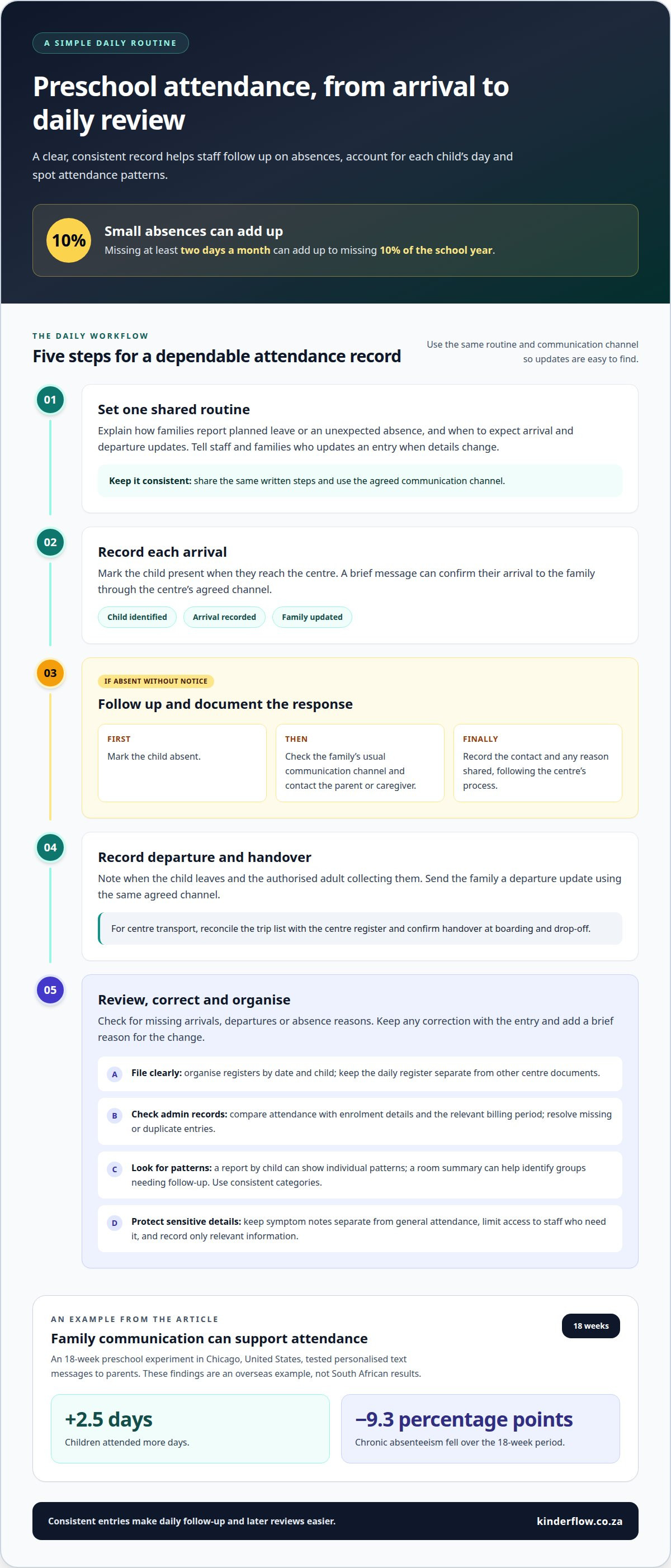
Missing at least two days a month can add up to missing 10% of the school year. That’s why knowing how to manage preschool attendance matters: a clear daily record helps educators notice absences, follow up with families and understand who was present. Attendance tracking also gives the centre a dependable record of each day.
Keeping attendance records can feel like one more task on a busy morning. A simple, consistent routine makes it easier to see who is present and keep administrative details in order. This article explains why attendance tracking matters, what to record and how daily summaries can reveal patterns in children’s attendance and preschool operations. It also shows how attendance information can support wider administrative records, from enrolments to billing, so fewer details get lost in the daily rush.
Key Takeaways
- Build a steady arrival and departure routine so families and educators share a clear picture of each child’s day.
- Keep attendance information connected to centre records to make everyday administration easier to follow.
- Use daily summaries to spot attendance patterns and understand how they affect children and preschool operations.
- Explore how Kinderflow ECD Centre Management Software can bring attendance tracking and other centre records together.
Table of Contents
Why is childcare attendance tracking important?
Knowing how to manage preschool attendance starts with recording who arrives, when they leave, and any absence. A consistent record helps staff respond to changes and gives families a clear account of each child’s day. Missing at least two days a month can add up to missing 10% of the school year. That makes each accurate entry useful, not just an administrative task.
Arrival and departure updates close the communication loop. Record a child’s arrival when they reach the centre, then note their departure and the authorised adult collecting them. Tell parents what updates to expect and how the centre will send them. For example, a brief message can confirm that a child has arrived or left with their caregiver. Use the same agreed channel so updates are easy to find.
What should staff do when a child is absent without notice? Mark the child absent, check the family’s usual communication channel, then contact the parent or caregiver to ask whether the child will attend. Record the contact and any reason shared, following the centre’s communication process.
Parents may see an occasional absence as harmless, especially when a child seems well at home. Explain that regular attendance helps children take part in routines, play and group learning. Keep the conversation practical and kind. Share the centre’s attendance expectations during enrolment, including how to report an absence and when to expect arrival or departure updates.
Staff and families both need a simple introduction when a new attendance system begins. Show staff how to record attendance, correct an error and enter a late arrival. Walk parents through the agreed check-in and notification steps, using a sample day to make the process clear. Give everyone the same instructions. A short refresher can help new staff and families follow the routine consistently.
Attendance tracking and administrative records
A consistent attendance record links each child’s daily presence with the centre’s enrolment and administrative information. Clear entries also make reviews and corrections easier.
Licensing requirements for attendance records
For a licensing or monitoring review, organise registers by date and child so staff can retrieve records without searching through unrelated files. Keep attendance status and any correction together, with a brief reason for the change. South African registration and monitoring processes can involve different records, so keep the daily register separate from other centre documents and follow the relevant instructions for each process.
Preschool attendance policy
A practical policy explains how staff record attendance, handle late arrivals and early departures, and document reported absences. It should also tell families how to notify the centre about planned leave or an unexpected absence. Specify who updates an entry when details change. Share the same written steps with families and staff so everyone can follow the centre’s process.
Preschool attendance records document a child’s presence at the centre. Compulsory-schooling requirements concern formal schooling under South African education rules, so keep them distinct from the preschool’s daily register.
Review entries before preparing billing records. Compare each child’s attendance with their enrolment details and the relevant billing period, then resolve missing or duplicate entries. For subsidised care, organise attendance information according to the applicable programme’s reporting instructions. A dated record and clear correction history can help staff explain how a figure was calculated.
Keep symptom flags and screening notes separate from general attendance entries. If a parent reports symptoms, record the absence and only the relevant information staff need for follow-up. Store sensitive details with appropriate access controls, and use the centre’s established process for handling them.
Clear digital attendance records can help keep daily entries and administrative reviews organised.
Effects of improved attendance on children and preschools
Regular attendance gives children more chances to join familiar routines, play and shared activities. As an overseas example, an 18-week preschool experiment in Chicago, United States, tested personalised text messages to parents. Children attended 2.5 more days, and chronic absenteeism fell by 9.3 percentage points over the 18-week period. These findings are not South African results, but they illustrate how family communication can support attendance. Accurate records help a preschool understand whether its own patterns are changing.
A preschool attendance policy should explain how families report planned holidays and extended absences, and how staff record those days. Ask parents to share expected dates and a return date, then record changes as they arise. This helps educators distinguish a planned break from an unexplained absence and prepare for a child’s return without guessing. A clear record also helps staff know which children to expect each day.
Record attendance each day, then review entries for missing arrivals, departures or absence reasons. A report by child can show an individual pattern, while a room summary helps staff see which groups need follow-up. For example, repeated absences on certain weekdays may prompt a respectful conversation with a family. Use consistent categories in every report so staff can compare records and spot changes without relying on memory.
For centre transport, record which children are expected on each trip and confirm each handover at boarding and drop-off. Staff should reconcile the transport list with the centre register when children arrive. Digital check-in and check-out can capture the essential steps: identify the child, record arrival or departure, and note who completed the handover. This gives staff a clearer daily record when reviewing a child’s movement between transport and the centre.
Protect children’s information by limiting access to attendance records to staff who need it for their roles. Record relevant details, such as an absence or authorised collection, without adding unnecessary personal notes. Keep screening or symptom information separate from general attendance entries. These practices help staff use records for care and administration while limiting exposure of private details.
Daily attendance summaries
A daily summary turns individual entries into a clear picture of the preschool day. Prepare it after the final arrival and departure updates, using the same date and room labels as the register. Include children expected, present, absent, late arrivals and early departures. Note any attendance entry that still needs follow-up. A consistent format helps the next staff member understand the day without piecing together separate notes.
Start by reviewing the day’s entries against each room’s register. Look for a child marked present without an arrival time, a departure without a recorded handover, or an absence without a reason. Correct errors through the centre’s usual process, then note what changed. For example, a late arrival entered after the first summary should appear in the final record.
Use the summary to guide practical decisions, not to label children or families. A room with several absences may need a quick staffing review. A child with repeated absences may need a thoughtful conversation with their family. Compare the daily record with earlier summaries to see whether a pattern is continuing or changing. Keep observations factual, such as “absent on Monday,” rather than guessing why.
Daily reports also help centre leaders connect attendance with operations. Check which rooms have complete records, whether planned activities had the children expected, and whether billing records need an attendance correction. Separate confirmed information from follow-up notes. This keeps the summary useful for planning and reduces confusion when staff revisit it later.
Close the daily routine by sharing relevant updates with the staff responsible for the next handover. Keep child-specific details private, and share only what each person needs for care and administration. A useful summary answers three things: who attended, what needs attention, and which record requires an update. Explore digital attendance summaries to bring daily attendance information into a clearer routine.
Kinderflow
Kinderflow ECD Centre Management Software connects attendance tracking with other preschool administration. It’s a practical next step when paper registers make it harder to keep attendance, enrolments and billing information together. Staff can use attendance registers alongside tools for enrolments, invoicing, learning milestones and multi-centre administrative overviews. This helps centre leaders connect daily information with the records they use for planning and administration.
If your current routine leaves attendance details scattered across paper sheets and separate records, Kinderflow offers a digital way to bring these tasks together. Contact Kinderflow to discuss how its ECD Centre Management Software could fit your preschool’s administrative routine.
Make attendance part of a calmer daily rhythm
A good next step is to choose one attendance routine your team can follow consistently. Decide who records arrivals, who updates changes and who reviews the day before closing. Keep the process clear enough for every staff member to use, including someone covering a different room. A shared routine helps records stay useful from drop-off through collection.
As you refine how to manage preschool attendance, make each step easy to repeat. Consider where paper sheets slow handovers or make daily information harder to find. A digital system may suit your centre if you want attendance records connected with wider administration.
Kinderflow offers Kinderflow ECD Centre Management Software for preschool administration. If you’re ready to explore a more connected attendance routine, contact Kinderflow about attendance. Take the next step at a pace that works for your team, and make more room for the children at the heart of each day.
Frequently Asked Questions
How can preschools encourage regular attendance and punctuality?
Make mornings predictable and attendance conversations supportive. Share practical ideas with families, such as setting a regular bedtime and preparing clothes and a backpack the night before. If a child often arrives late, discuss what makes the morning difficult and agree on a manageable routine together. Recognise steady effort with a warm welcome, not public comparisons between children or families.
How should preschools manage late arrivals, early pickups, and sign-in procedures?
Use one arrival and collection process throughout the centre. For a late arrival, record the child’s arrival time and tell the room staff they have joined. For an early pickup, note the departure and record who collected the child under the centre’s authorised collection process. If a caregiver changes plans, confirm the update through the family communication process before releasing the child.
How should preschools handle illness, contagious diseases, and return-to-school rules?
Set out a clear illness process for families and staff, including how parents report symptoms, how the centre records an illness-related absence, and how return decisions follow the centre’s health guidance. For example, a parent reporting a fever can be directed to the relevant policy, while staff record the absence without unnecessary medical detail. Apply the process consistently and communicate updates directly to families.
What attendance rates and absence patterns should preschool managers track?
Track attendance by child and room over time, then look for repeated absences, frequent late arrivals and changes after school holidays. Calculate attendance using the children expected each day as the comparison group, and keep the method consistent across reports. A centre-wide figure can hide a child who needs a conversation with their family, while a child-level view can help staff respond thoughtfully without treating one missed day as a pattern.
Frequently asked questions
How can preschools encourage regular attendance and punctuality?
Make mornings predictable and attendance conversations supportive. Share practical ideas with families, such as setting a regular bedtime and preparing clothes and a backpack the night before. If a child often arrives late, discuss what makes the morning difficult and agree on a manageable routine together. Recognise steady effort with a warm welcome, not public comparisons between children or families.
How should preschools manage late arrivals, early pickups, and sign-in procedures?
Use one arrival and collection process throughout the centre. For a late arrival, record the child’s arrival time and tell the room staff they have joined. For an early pickup, note the departure and record who collected the child under the centre’s authorised collection process. If a caregiver changes plans, confirm the update through the family communication process before releasing the child.
How should preschools handle illness, contagious diseases, and return-to-school rules?
Set out a clear illness process for families and staff, including how parents report symptoms, how the centre records an illness-related absence, and how return decisions follow the centre’s health guidance. For example, a parent reporting a fever can be directed to the relevant policy, while staff record the absence without unnecessary medical detail. Apply the process consistently and communicate updates directly to families.
What attendance rates and absence patterns should preschool managers track?
Track attendance by child and room over time, then look for repeated absences, frequent late arrivals and changes after school holidays. Calculate attendance using the children expected each day as the comparison group, and keep the method consistent across reports. A centre-wide figure can hide a child who needs a conversation with their family, while a child-level view can help staff respond thoughtfully without treating one missed day as a pattern.